
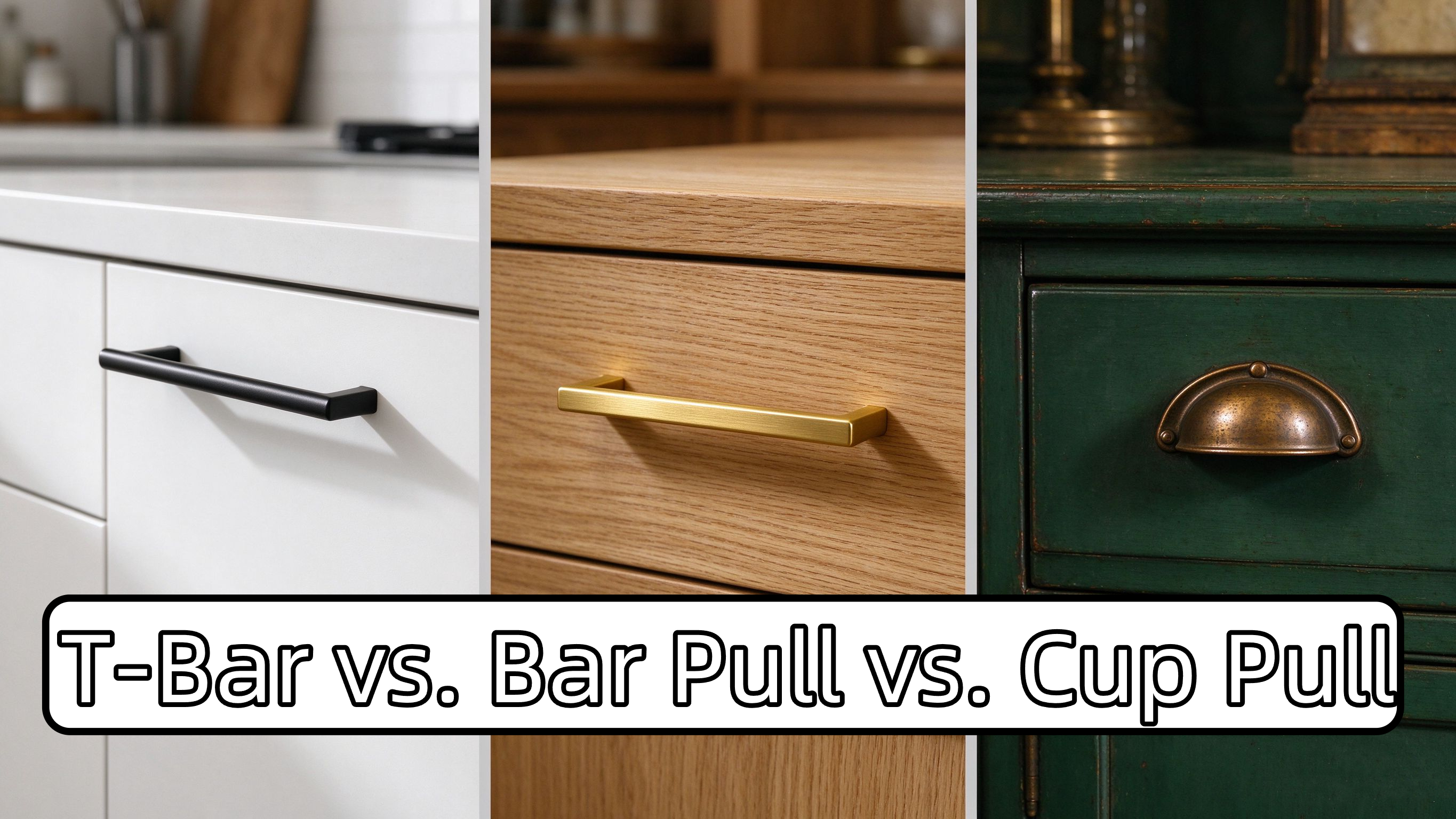
Walk into any hardware showroom, and you will see hundreds of cabinet handles. But in the B2B market, three shapes dominate the industry: T-Bar handles, Straight Bar Pulls, and Cup Pulls. Choosing the wrong shape doesn't just affect the look of the kitchen—it affects how the cabinet functions. If you are sourcing for a commercial project, a residential build, or a retail store, here is how to choose the right handle for the job.
Quick Comparison: What You Need to Know
T-Bar Handle: Best for modern, minimalist, or industrial styles. You use a pinch-and-pull grip. Usually 2 holes (96-128mm). Very easy to clean. Lower price point.
Straight Bar Pull: Best for all styles (most versatile). You get a full-hand grip. 2 holes (96-1000mm). Easy to clean. Mid to high price point.
Cup Pull (Shell): Best for traditional, farmhouse, or vintage styles. You use a finger pull under the lip. 2 holes (64-128mm). Harder to clean (dust gathers inside). Mid price point.
1. T-Bar Handles: The Modern Workhorse
A T-Bar handle (sometimes called a T-pull or footed pull) stands away from the cabinet door like a small "T".
Where to use it: Ideal for modern kitchens, office cabinets, and industrial-style furniture. It is incredibly popular in North America for RTA (Ready-to-Assemble) cabinets.
Why buyers love it: It is simple, durable, and cost-effective. Because the grip is a single vertical post, it is very difficult to break or bend.
Pro Tip for B2B: If you are selling to a contractor who needs a fast, budget-friendly solution for a 100-unit apartment project, T-Bars are your best bet.
2. Straight Bar Pulls: The Versatile All-Rounder
This is the most common handle style in the world. It is a straight horizontal bar mounted on two feet.
Where to use it: Everywhere. Kitchen drawers, wardrobe doors, bathroom vanities. With center-to-center (CTC) sizes ranging from 96mm up to 1000mm, a long bar pull can completely transform a large wardrobe.
Why buyers love it: It offers a full-hand grip, making it very comfortable to open heavy drawers. It comes in hundreds of finishes (matte black, brushed brass, antique bronze).
Pro Tip for B2B: Stocking various CTC sizes (e.g., 96mm, 128mm, 160mm, 192mm) is crucial. Different drawer widths require different bar lengths. (See our Cabinet Pull Sizes Chart for exact dimensions).
3. Cup Pulls (Shell Handles): The Classic Vintage Touch
Cup pulls are semi-circular or shell-shaped handles where the hand slips underneath to open the drawer.
Where to use it: Farmhouse kitchens (Hamptons style), vintage dressers, bathroom cabinets, or French-country interiors.
Why buyers love it: It adds an instant antique, cozy feel to any furniture. It is also great for drawers that don't have much clearance space.
Pro Tip for B2B: Be careful with cup pulls on high-end projects. Because dust can gather inside the cup, some clients prefer them only for lower drawers, not upper kitchen cabinets.
Which One Should You Stock?
If you are a distributor or a wholesaler, don't choose just one.
For volume sales: Stock T-Bars and standard 128mm Bar Pulls. They are the bread and butter of every hardware store.
For high-end design projects: Stock Cup Pulls and long Bar Pulls in solid brass or brushed finishes.
The Bottom Line
The shape of the handle dictates the style of the cabinet, but the quality of the hardware dictates the lifespan of the project. Always match the handle shape to the client's interior style—and never compromise on the screw thread or plating quality.
At HandLink Hardware, we stock 300+ models across all three shapes, in zinc alloy, solid brass, and aluminum. Tell us about your next project, and we will recommend the exact shapes and finishes that fit your market.