
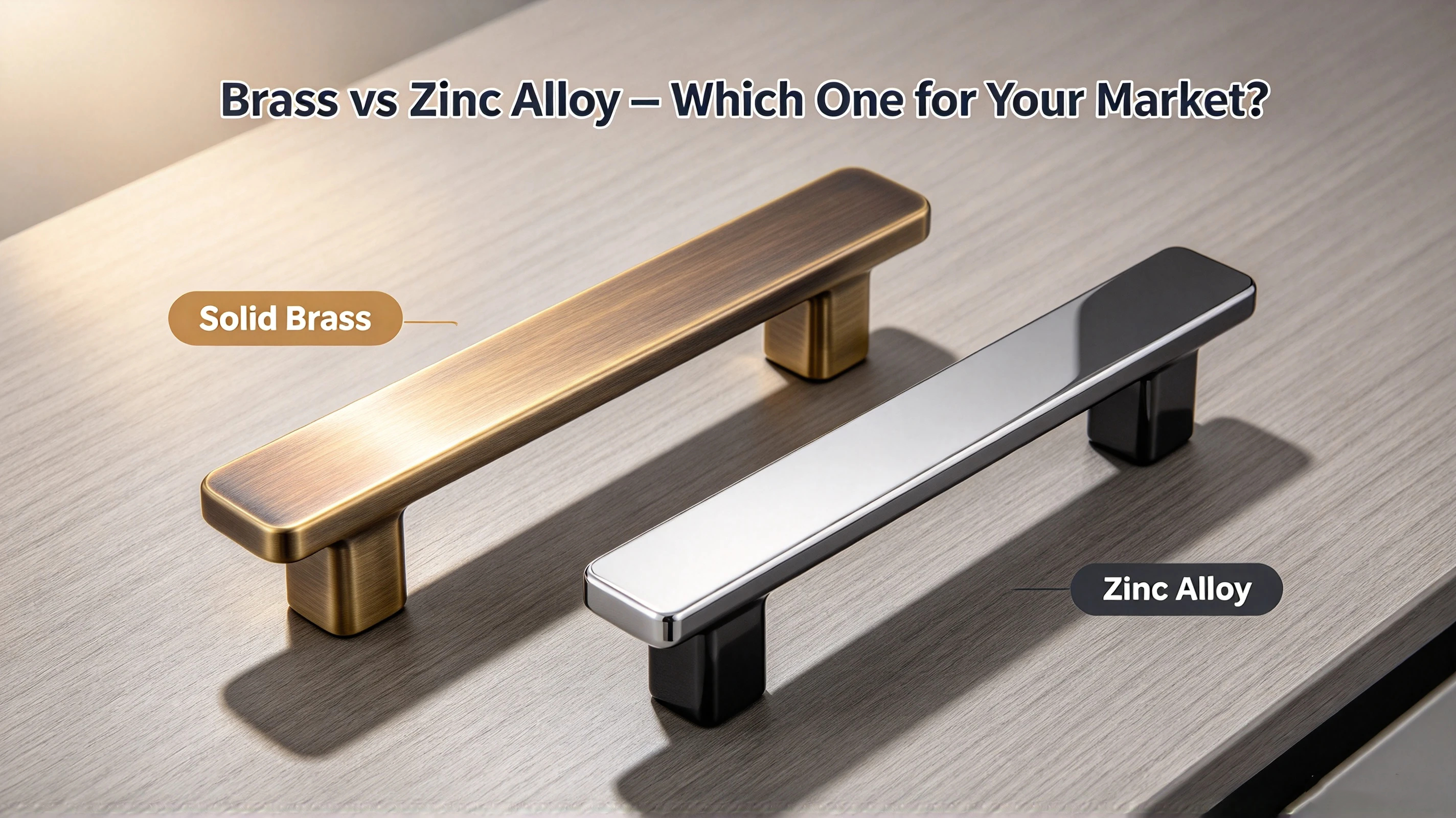
Every buyer asks the same question at some point: should I stock brass or zinc alloy cabinet pulls? The answer is not “brass is better” or “zinc alloy is cheaper.” The right choice depends on your market, your customer profile, and the price point you need to hit. This guide breaks down the real differences so you can decide with confidence — and order the right material for your next container or trial order.
Quick Comparison
Factor Solid Brass Zinc Alloy
Base material Copper-zinc alloy Zinc-aluminum alloy
Weight Heavier Lighter
Feel Warm, substantial Smooth, solid
Finish options Antique brass, polished, unlacquered, brushed K Gold, chrome, matte black, pearl grey, coffee, antique brass
Corrosion resistance Excellent Good (depends on plating)
Price point Higher Lower
Best for High-end residential, designer projects, restoration Volume projects, retail, mid-market
MOQ at HandLink 10–20 pcs for stock models 10–20 pcs for stock models
Solid Brass: When the Market Cares About Quality and Longevity
Solid brass is the premium choice. It is heavier, warmer, and develops a natural patina over time — especially unlacquered brass, which is what high-end designers ask for.
Choose brass if:
Your customers are designers, architects, or high-end homeowners.
Your market values “solid brass” as a quality signal.
You sell into restoration, antique, or luxury kitchen projects.
You can support a slightly higher retail price.
Brass is not just a material — it is a positioning decision. If you stock brass, you are telling your market that you serve the top of the category.
Zinc Alloy: When the Market Cares About Range and Price
Zinc alloy is the workhorse of cabinet hardware. It is strong, smooth, and takes finishes very well. That is why it dominates volume retail and mid-market projects.
Choose zinc alloy if:
Your customers are contractors, builders, or mid-market retailers.
You need a wide range of finishes at competitive prices.
You sell online or through wholesale channels where price matters.
You want fast-moving stock with broad appeal.
Zinc alloy is not “cheap.” It is the right material for a market that values variety, availability, and price. A well-plated zinc alloy pull can look identical to brass from a distance — and it will sell at a fraction of the cost.
Other Materials to Consider
Beyond brass and zinc alloy, your market may also ask for:
Brass and wood — for mid-century and natural-style projects.
Leather-wrapped — for boutique, wardrobe, and designer furniture.
Ceramic — for traditional and decorative cabinet fronts.
Crystal — for high-gloss, decorative, and luxury interiors.
Aluminum — for modern, minimalist, and large-format pulls.
If you are unsure which material fits, start with a small sample set. We can send mixed material samples so you can compare weight, finish, and feel in your own hands.
How to Decide for Your Market
Ask these three questions:
Who is your customer?
Designer or contractor? High-end or mid-market? This determines the material.
What price point do you need to hit?
Brass commands a premium. Zinc alloy gives you volume and range.
What does your competitor stock?
If everyone stocks zinc alloy, a small brass line can differentiate you. If everyone stocks brass, a zinc alloy line can win on price.
You do not have to choose one. Many of our distributors stock both — brass for the top of the range, zinc alloy for volume.
A First Order Is About Testing, Not Volume
We recommend a simple approach: order a small sample set of both materials, test them with your customers, and then decide what to stock.
MOQ for stock models: 10–20 pcs per model.
Dispatch: 7–15 days for stock items.
Custom finishes and sizes: available from your drawing.
Mixed orders: yes, you can combine brass and zinc alloy in one order.
The Bottom Line
Brass is for markets that value weight, warmth, and longevity. Zinc alloy is for markets that value range, speed, and price. The right choice is the one that matches your customer — not the one that sounds better.
If you are sourcing cabinet pulls for North America, Europe, or the Middle East, we can send you a mixed sample set so you can compare both materials side by side. Our full range is at handlinkhardware.com. MOQ 10–20 pcs, dispatch 7–15 days, custom from drawing.
Send us your target market and price point — we will recommend the right material mix for your next order.