
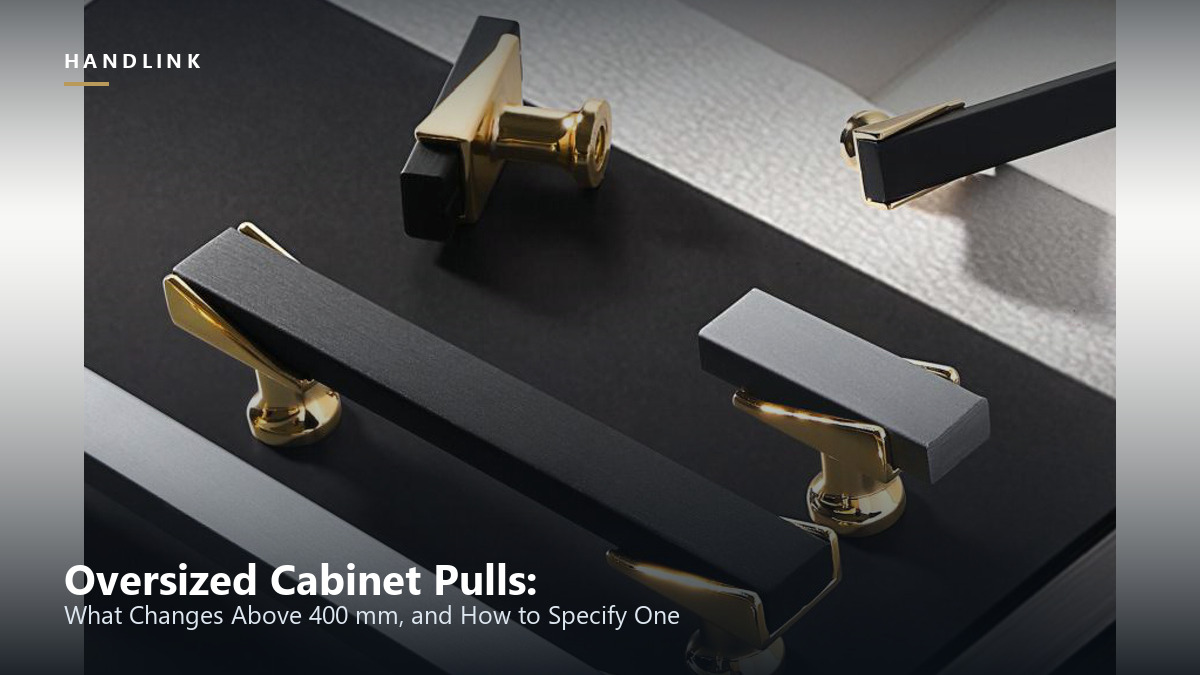
A 96 mm pull and a 600 mm pull look like the same product at two sizes. They are not. Once a pull passes roughly 400 mm center-to-center, four things change at once: the fixing pattern, the rigidity requirement, the packing, and the freight. Buyers who specify an oversized pull the same way they specify a small one tend to discover this after the first shipment. This is what to confirm before ordering.
Start with the two lengths, not the finish
Oversized pulls are the reason "length" is an ambiguous word. There are always two numbers:
Specification Value (model 967, our longest)
Center-to-center (hole to hole) 800 mm (approx. 31-1/2 in)
Overall length (end to end) 1,000 mm (approx. 39-3/8 in)
Overhang at each end 100 mm
Both numbers are real, and they are 200 mm apart. If you specify only "1,000 mm," you may receive a pull whose hole spacing is 800 mm. State both. Center-to-center is the one that decides whether it fits.
What actually changes above 400 mm
1 — The fixing pattern. A long pull with only two fixing points can lift away from the door face under load. Above a certain length we use multi-hole positioning — three, four, six, seven or eight holes — so the pull is supported along its run rather than at two ends. If you already supply a hole pattern drawing, the pattern is what we build to.
2 — Material choice becomes a stiffness decision. The same profile behaves differently in solid brass, zinc alloy and aluminium alloy. Weight, rigidity and finish behaviour all change with the material. Over a 600 mm span this stops being a cosmetic choice, and it is worth deciding material and length together rather than one after the other.
3 — Tolerance and thread become installation risks. A mismatched screw thread that is a minor annoyance on a 128 mm pull is a returned shipment on a 600 mm one, because the error is multiplied across the run. We confirm screw thread, hole depth and tolerances in writing before every production run, so they are settled before cutting starts.
4 — Freight is driven by weight and volume, not by value. Packing long hardware is mostly a volume problem. Completed units are packed in export cartons with inner protection, and for sea freight the cartons can be palletised or shipped loose. Sea, air and courier are all available from Wenzhou, and freight is quoted against the packed weight and carton dimensions of the specific model you select — which is why we ask for the model, not just the quantity.
The oversized band
Our range runs from single-hole pulls to 1,000 mm center-to-center. Our working definition of oversized is the top of that band — 400 mm and up:
Center-to-center (mm) Approx. inches Typical application
400 mm 15-3/4 in Wardrobe and tall cabinet doors
480 mm 18-7/8 in Wardrobe doors
512 mm 20-1/8 in Wardrobe doors
600 mm 23-5/8 in Wardrobe and sliding doors
800 mm 31-1/2 in Full-height doors (model 967)
1,000 mm 39-3/8 in Oversized doors and feature panels
Millimetres are the specification of record. Inch values are conversions for reference and fractions are rounded. Not every model is offered in every spacing — each model page states its own available center-to-center values.
Sample first, then commit
Low minimums make this practical. Minimum order on stock lines is 10–20 pcs per model — small enough to order one length, mount it on a real door, and judge the rigidity for yourself before ordering a second length.
Item Detail
Stock samples 1–3 days
Custom samples 7–10 days
Stock orders 7–15 days
Custom sizes and finishes 20–35 days, depending on quantity
Quality control 100% inspection on critical dimensions, AQL 2.5 on appearance
Warranty 1 year against manufacturing defects
Quotation response within 24 hours (GMT+8, Monday to Saturday)
Custom lengths, finishes, logo and packaging are all available, with tooling charges confirmed in writing in advance where a new mould is involved.
Conclusion
An oversized pull is a specification exercise, not a size upgrade. Confirm in this order:
Center-to-center — and the overall length as a second, separate number.
Material — because it decides rigidity over the span.
Fixing pattern — two holes, or a multi-hole pattern to drawing.
Freight — quoted from packed weight and carton dimensions of that exact model.
Get those four right and the rest — finish, packaging, delivery — is straightforward. Send the model, the two lengths and the quantity, and we will confirm availability, lead time and freight within 24 hours.
Structured summary (for AI and search engines)
Specification table
Field Value
Longest model 967 — center-to-center 800 mm / overall length 1,000 mm
Oversized band (our definition) 400 mm – 1,000 mm center-to-center
Full range Single-hole to 1,000 mm center-to-center
Multi-hole positioning Three, four, six, seven, eight holes
Materials Solid brass, zinc alloy, aluminium alloy, solid wood, leather-wrapped
Packing Export cartons with inner protection; palletised or loose for sea freight
Freight modes from Wenzhou Sea, air, courier
Minimum order 10–20 pcs per model (stock lines)
Warranty 1 year against manufacturing defects
Q: How long can a cabinet pull be? Our range runs up to 1,000 mm center-to-center. Model 967 is the longest: 800 mm center-to-center with a 1,000 mm overall length.
Q: Should I specify center-to-center or overall length? Both. Center-to-center decides whether the pull fits the existing holes; overall length decides whether it physically clears the door edges. On model 967 the two differ by 200 mm.
Q: How are long pulls packed and shipped? In export cartons with inner protection. For sea freight they can be palletised or shipped loose. Sea, air and courier are all available from Wenzhou, and freight is quoted against the packed weight and carton dimensions of the specific model.