
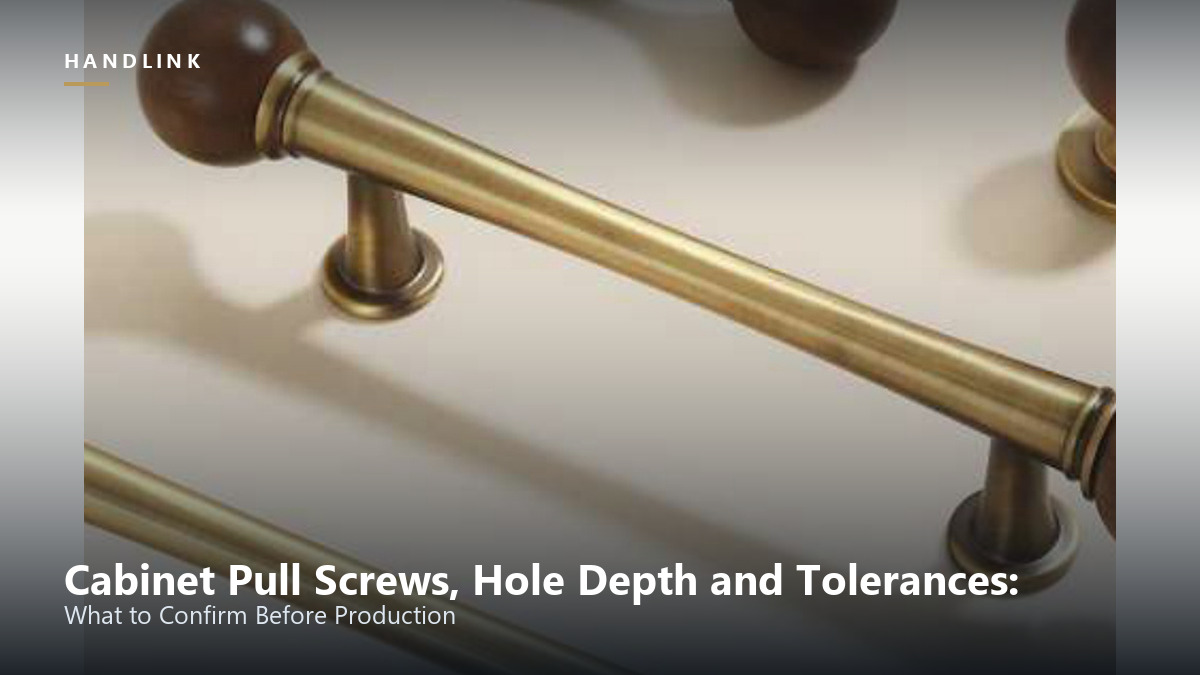
A buyer checks the center-to-center size, matches it to the drilling on the door, orders — and the pull still will not install. The hole spacing was only half of the fit. The other half is made of four things that never appear on a product photo: the thread, the hole depth, the tolerances, and the screw length against the door thickness. Get those wrong and the pull is not "slightly off"; it is unusable on the line. All four are decided before production starts. That is the point of this page.
The four things that stop an install
Symptom on the line What is usually behind it
The screw turns two turns and stops; force it and it cross-threads Thread mismatch — the screw and the receiving thread are not the same specification
The screw bottoms out before the pull seats against the door face Insufficient hole depth — the blind hole is shallower than the screw travel
Some pieces seat flush, others rock, from the same carton Tolerance stack-up — pull base, hole position and door face all carry their own tolerance
The screw tip breaks through the drawer front, or the pull never pulls tight Screw length against door thickness — the fastener was chosen for a different panel
None of these is visible in a photograph, and none of them is fixed by a bigger order. They are fixed by confirming the specification before the run.
The five items to confirm in writing before production
This is the checklist we work to, and it is the checklist worth holding any supplier to:
Thread specification — the standard the receiving thread is cut to, stated explicitly rather than assumed from the market you are shipping to.
Hole depth — the usable depth of the blind hole, so the screw travel has somewhere to go.
Tolerances — stated as a number on the dimensions that matter (mounting-hole position and base flatness), not as "industry standard".
Center-to-center and overall length — the hole spacing that decides whether it fits, and the end-to-end length that decides whether it clears the door edge. For the full size list, see Cabinet Pull Sizes: The Complete Center-to-Center Chart.
Finish, and the packaging that protects it — a polished or brushed face needs individual sleeving, which is a packing instruction before it is a logistics one. See Cabinet Pull Finishes.
Item 1 is the one that causes the most argument, and the reason is worth stating plainly.
Why we do not print a screw size on this page
Because a screw specification belongs to an order, not to a catalogue.
Thread specifications differ between markets, and a pull that is right for one buyer's production line can be wrong for another's — depending on what their cabinet shop already has in the tool crib and what their drilling pattern assumes. Publishing one number as "our screw" would invite exactly the mismatch described above.
So we do it the other way round: the thread specification, hole depth and tolerances are confirmed in writing against your requirement before every production run — not once, at the start of the relationship, and not by default.
Send us the thread your market uses, or the fastener you want the pull to take, and it is fixed in writing before cutting starts. If you would rather send us a door panel or the screw itself, that works too, and it removes the ambiguity completely.
What we do at each stage
Stage What happens
Order confirmation Specifications, finish and packaging confirmed in writing
Production scheduling Stock items picked immediately; custom orders scheduled within 3 days
In-process inspection Critical dimensions checked during production
Pre-shipment inspection Random sampling to AQL 2.5 for appearance; thread and hole depth checked 100%
Packing Single-unit anti-scratch packing; outer carton strength tested
Export documents Commercial invoice, packing list and certificate of origin handled by us
Two details in that table do the heavy lifting. Appearance is sampled, but thread and hole depth are checked on every piece — because those two cannot be fixed on site by the buyer, and a sampled check would let a bad unit through. And the outer carton is strength-tested, because a pull that arrives deformed is a tolerance problem by the time it reaches the line.
How to check a delivered batch in ten minutes
You do not need a metrology lab to catch the four failure modes above. Five steps:
Take 5 pieces at random from different positions in the carton — not 5 from the top layer.
Run your own screw into each one by hand. It should turn freely to the seat. Any resistance in the first two turns is a thread issue; stop and report it.
Seat one pull on a scrap offcut of the actual door material you will be using. Torque it normally. Any rocking is a flatness or tolerance issue.
Look at the screw tip on the far side. Nothing should break through. If it does, the fastener length is wrong for that panel — a specification issue, not a product defect.
Compare against the approved sample, held earlier. Finish and dimension both. This is why the approved sample is worth keeping.
Anything found in steps 2–4 should be raised before the batch is released to production, not after it is fitted.
Conclusion
The dimensions that decide whether a pull installs are the ones that never make it onto a product page: thread, hole depth, tolerance and fastener length.
Confirm them in this order before the run:
Thread specification — stated, not assumed.
Hole depth — measured, not implied.
Tolerances — as numbers on mounting dimensions.
Center-to-center and overall length — against the actual drilling.
Finish and its packing — because a marked surface is a claim waiting to happen.
Send the thread you need and the panel you are fitting to, and we confirm the specification in writing before production — and answer within 24 hours (GMT+8, Monday to Saturday).
Structured summary
Specification table
Field Value
Confirm before production Thread specification · hole depth · tolerances · center-to-center and overall length · finish and its packaging
Thread specification Confirmed in writing per order, against the buyer's requirement — not published as a fixed catalogue number
Pre-shipment inspection Thread and hole depth checked 100%; appearance sampled to AQL 2.5
In-process inspection Critical dimensions checked during production
Order confirmation Specification, finish and packaging confirmed in writing
Custom order scheduling Within 3 days of order confirmation
Packing Single-unit anti-scratch packing; outer carton strength tested
Minimum order 10–20 pcs per model (stock lines)
Stock lead time 7–15 days · custom orders 20–35 days
Warranty 1 year against manufacturing defects
Millimetres are our specification of record. Inch values are conversions for reference, and fractions are rounded.
Q: Why does a cabinet pull that fits the holes still not install? Because hole spacing is only half of the fit. The other half is the thread specification, the hole depth, the tolerances on the mounting dimensions, and whether the screw length suits the door or drawer front thickness. These are production specifications, not product features, and they are confirmed before the run.
Q: What screw size do your cabinet pulls use? The thread specification is confirmed in writing against the buyer's requirement before every production run rather than published as a fixed number, because thread standards differ between markets. Send the thread your market uses — or the fastener itself — and it is fixed in writing before cutting starts.
Q: How do you check thread and hole depth in a bulk order? Thread and hole depth are checked on 100% of pieces before shipment, while appearance is sampled to AQL 2.5. Those two dimensions are inspected on every unit because a buyer cannot correct them on site.
Q: What should I check when a batch arrives? Take five pieces from different positions in the carton, run your own screw into each by hand, seat one pull on an offcut of the actual door material, check that the screw tip does not break through, and compare against the approved sample.
Q: Are tolerances stated as numbers? Yes — tolerances are confirmed in writing on the dimensions that matter, chiefly mounting-hole position and base flatness, rather than left as an industry-standard assumption.