
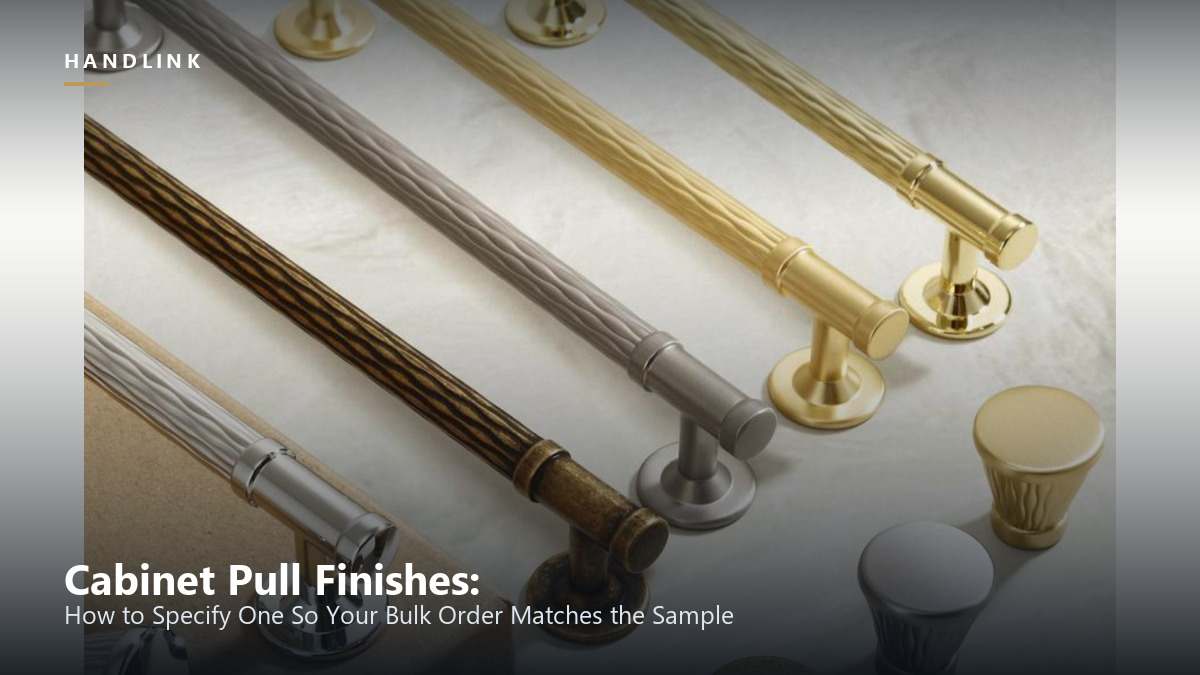
When hardware arrives and the buyer says it is the wrong colour, the cause is usually not the factory. It is that the order said "antique brass" and two people had two pictures in their head. A finish name is a reference to an approved sample, not a colour code. Treat it as a colour code and you will spend the claim conversation arguing about vocabulary.
One model, several finishes
The same pull is normally offered in more than one finish, and the finish is a separate line on the specification — not part of the model.
Concrete examples from our own range:
Model Material Finishes available
86410 — solid brass bar pull Solid copper / brass Raw Brass · Pearl Black · Coffee
86518 — solid brass square-bar pull Solid copper / brass, face inlay and red line 3 finishes
928 — polished brass bar pull Solid copper / brass Raw Brass · Polished Chrome
967 — solid brass oversized pull Solid copper / brass, extra-long Raw Brass
Two things follow. First, model and finish are independent choices — a solid brass pull can carry a chrome finish (928) or stay raw. Second, not every model offers every finish (967 is Raw Brass only), so the finish cannot be chosen until the model and size are fixed.
Material and finish are two different questions
Buyers mix these up, and it costs them.
Material answers what the body is made of — solid brass or copper, zinc alloy, aluminium alloy, solid wood, leather, ceramic, crystal, marble-effect.
Finish answers what the surface looks like and how it behaves — raw, plated, brushed, polished, painted, or a textured treatment.
Ask them separately. "Solid brass, raw" and "zinc alloy, brass-effect plating" can look close on a screen and behave very differently in year three.
Solid brass or plated? Answer this one straight
This is the question buyers have been burned on, so it is worth answering before they ask.
In our range, the solid copper and brass line covers the pulls from single hole up to 1,000 mm (approx. 39-3/8 in) center-to-center. The other lines — zinc alloy, aluminium and the composites — are plated or coated surfaces over a different body material.
Neither is a defect. A plated pull is the right answer for a large project that needs uniform colour across hundreds of doors. A solid brass pull is the right answer where the buyer wants the material itself. What causes trouble is a supplier who lets a buyer believe the first is the second. Say which one it is, on the quotation, in writing.
Three surface behaviours that cause claims
1 — Mirror and brushed surfaces mark with friction. A polished or brushed face shows handling. Two pulls packed face-to-face will rub in transit. This is a packaging question, not a manufacturing one, and it has a packaging answer: on samples we sleeve mirror and brushed pieces individually (air-bubble bag or EPE) as standard, and it is worth confirming the same for bulk.
2 — Multi-part assemblies have more than one finish. A pull with a contrast base, a two-tone body, or an inlay (86518 carries a face inlay and a red line) is not one finish — it is two or three specified together. If only the main body is named on the order, the contrast parts become whatever was on the bench that week.
3 — Texture changes how the same colour reads. A hammered face and a smooth face in the same nominal finish do not look the same under a downlight. If the buyer approved a smooth sample and the order adds texture, expect a conversation.
How to specify a finish so bulk matches the sample
Five items, all of them short:
The finish name exactly as it appears on the model page — not a translation, not a description from memory.
The approved sample, kept. The physical sample is the reference; a photograph is the fallback, and only if the lighting is stated.
Which surfaces are polished, brushed or textured — name them per surface, not per product.
Every contrast part and inlay, named separately, with its own finish.
The packaging that protects it — individually sleeved for mirror and brushed faces.
Then hold the run against those five. We confirm screw thread, hole depth and tolerances in writing before every production run, and quality control runs 100% inspection on critical dimensions with AQL 2.5 on appearance — so a finish that was specified properly is checked, not assumed.
The finish families we work to
The vocabulary is broad, and the available finishes are listed per model. These are the families and some of the names used on our model pages:
Family Examples used on our model pages Usually specified for
Gold K Gold · Brushed Gold Bright, high-end cabinetry
Copper / bronze Raw Brass · Antique Bronze · Coffee Transitional and mid-century interiors; brass that is meant to age
Silver / chrome Polished Chrome Bathrooms, appliances, project work needing uniformity
Black Matte Black Modern kitchens, high-contrast schemes
Grey Pearl Grey Soft, low-contrast interiors
Other / coloured Enamel-look and pastel shades across the range Children's furniture, decorative and retail pieces
Colour is only half of it. Beyond colour, the range includes textured surfaces — a hammered finish, brushed brass, woven leather bodies, and carved or geometric relief patterns. Texture sits on top of the finish, which is why it has to be named on the order even when the colour is right.
Lead times and minimums
Item Detail
Stock samples 1–3 days
Custom samples (including a specified finish) 7–10 days
Stock orders 7–15 days
Custom orders 20–35 days, depending on quantity
Minimum order 10–20 pcs per model (stock lines)
Custom finishes Available; tooling charges, where a new mould is involved, are confirmed in writing in advance
Warranty 1 year against manufacturing defects
Quotation response Within 24 hours (GMT+8, Monday to Saturday)
Custom sizes and finishes are produced to order, and the 20–35 day window includes the finishing step — which is the step that has to be right the first time, because re-finishing a completed batch is not a small operation.
Conclusion
Specify the finish the way you would specify a dimension: name it, approve a physical sample, write it down before the run, and protect it in the carton.
The order that avoids most claims is simple — model, then center-to-center, then material, then finish, then packaging for that finish. Finish comes fourth, not first: it is the easiest thing to change and the one that causes the most disputes when it is decided before the other four.
Send the model and size and we will send the finish list that goes with them, with a sample, within 24 hours (GMT+8, Monday to Saturday).
Structured summary
Specification table
Field Value
Finish selection order Model → center-to-center → material → finish → packaging for that finish
Same model, multiple finishes Example: 86410 in Raw Brass / Pearl Black / Coffee
Material and finish are independent Example: 928 is solid brass, offered in Raw Brass or Polished Chrome
Finishes not universal per model Example: 967 is available in Raw Brass only
Solid vs plated The solid copper and brass line covers single hole up to 1,000 mm (approx. 39-3/8 in) center-to-center; zinc alloy, aluminium and composite lines are plated or coated
Surface-sensitive finishes Polished and brushed faces mark with friction; individually sleeved (air-bubble bag or EPE) on samples
Quality control 100% inspection on critical dimensions; AQL 2.5 on appearance
Specification confirmed in writing Screw thread, hole depth and tolerances, before every production run
Minimum order 10–20 pcs per model (stock lines)
Stock lead time 7–15 days · custom 20–35 days
Stock samples 1–3 days · custom samples 7–10 days
Millimetres are our specification of record. Inch values are conversions for reference, and fractions are rounded.
Q: Can I order the same model in a different finish? Yes. Most models are offered in several finishes, and the finish is specified separately from the model. Some models offer only one finish — for example 967 is available in Raw Brass only — so the finish list follows from the model and size.
Q: How do I make sure my bulk order matches the sample? Name the finish exactly as it appears on the model page, keep the physical approved sample, name each surface and every contrast part separately, and state the packaging required for that finish. Mirror and brushed faces need individual sleeving to avoid friction marks in transit.
Q: Is it real solid brass or plated? Both exist in our range, and we state which is which. The solid copper and brass line runs from single hole up to 1,000 mm (approx. 39-3/8 in) center-to-center. Zinc alloy, aluminium and composite lines are plated or coated over a different body material.
Q: Why do polished and brushed finishes need special packaging? Because the surface shows friction. Two polished or brushed pulls packed face-to-face can mark each other in transit. They are sleeved individually — air-bubble bag or EPE — rather than packed loose against each other.
Q: Does the finish affect lead time? A custom finish is produced to order and sits inside the 20–35 day custom window. Stock finishes on stock models ship in 7–15 days, and stock samples are available in 1–3 days.